
 Shop
ShopJust Five More Minutes
Daria thinks Christian’s endless checking is just stalling, and she rides off without his okay. Christian noticed that a wheel was loose but only said so in between a lot of “maybes.” Whose fault is it when caution was right but nobody was listening anymore?
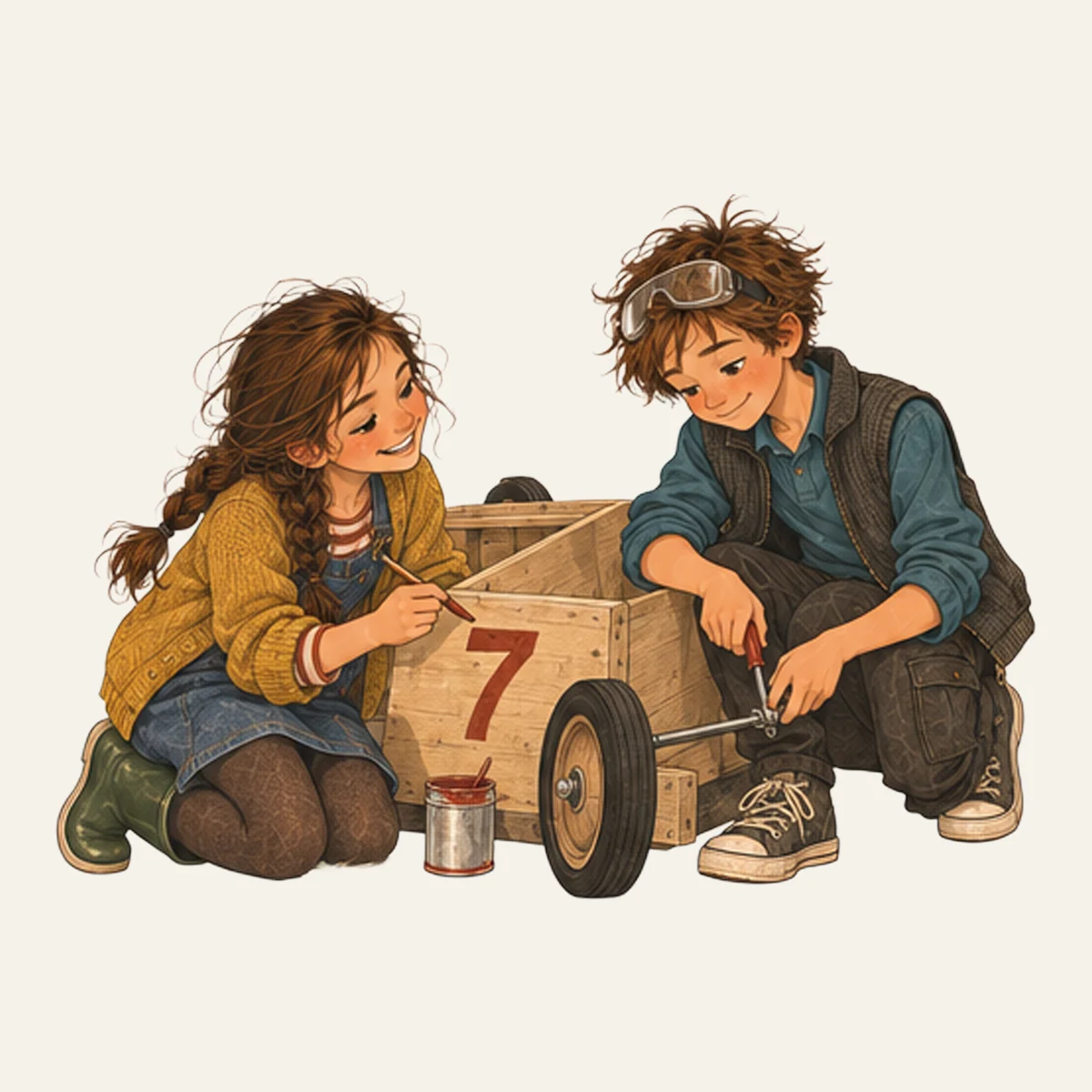
The go-kart had been sitting on the garden path between the apple tree and the shed since noon, and Daria had already sat in it twice. Not to ride it. To test-sit it, as she called it, both hands on the steering rope, eyes on the dirt path behind the hedge that slopes gently down to the creek. Two weeks of fall break were in that kart: a fruit crate from Mr. Berger’s basement, a board Daria’s dad had left over, four wheels from an old wagon, and a brake made out of a wooden block that Christian had built from a sketch he drew last summer at Grandpa Werner’s by the ocean. On the side, in yellow paint, it said “Daria & Co.” and underneath, smaller and very neat: “Engineering: C. Becker.”
“Come on,” Daria said. “It gets dark at five.”
Christian was lying on his back under the kart, turning the nut on the left front wheel. “Hang on. Just five more minutes.” It was the third time he’d checked the wheels. The first time he had tightened every nut, the second time he had measured the axles with a folding ruler, and now he was spinning each wheel one at a time and listening to it, like it had something to tell him.
“You said that half an hour ago,” Daria said. “And before that. One minute. Not two.” “Measure twice, cut once,” came the voice from below. “We’re not cutting anything anymore!” Christian slid out a little, a pencil behind his ear. “The left front wheel might have a little play in it. I think. I need to go over it again with the big wrench...” Daria heard “might” and “again,” and she had heard those two words about twenty times that afternoon. Christian got up and went into the shed to look for the big wrench.
She pulled the kart through the garden gate onto the dirt path. Just the flat part, she thought, just to the post, just to see if it rolls. She sat down, pushed off the gravel with both hands, and the kart rolled. Better than she’d expected. The wind tugged at her ponytail, the gravel crunched, and Daria laughed out loud. After maybe twenty yards there was a click. The kart tilted left, and the left front wheel passed her, rolled on by itself, and tipped over into the grass. The kart scraped along the path, spun halfway around, and threw Daria onto her side, knee first.
Christian came running with the wrench in his hand, his face whiter than she had ever seen it. “Are you okay?” Daria was sitting in the grass, holding her knee. Her tights had a hole in them, and underneath it was red and full of little stones. Christian looked at the knee first, then at the axle. The nut was lying a little way off in the gravel. He picked it up and set it on his flat palm. He didn’t say “I told you so.” He didn’t say anything, and that was worse.
There was a first-aid kit in the shed. Christian had put it there in the spring, “just in case,” and Daria had laughed at him. Now they were sitting on the step in front of it, and Daria was sticking a Band-Aid on her knee. “You could have said stop,” she said. “I said it was loose.” “You said ‘might.’ And ‘five more minutes.’ You’ve been saying that for three hours.” Christian opened his mouth and closed it again. He was doing math; you could see it. Then he said quietly, “If I say hang on ten times, you don’t hear the eleventh. Even if the eleventh is true.”
Daria pulled her knees up. “And I took off while you were in the shed. Without asking.” She picked at the edge of the Band-Aid. “I was being pushy.” It wasn’t the first time she’d said that, and it wasn’t any easier than the first time. Christian turned the nut over in his fingers. “You were right that I check stuff for too long. And I was right that it was loose.” Daria laughed even though her knee stung. “So we were both right, and I’ve got a hole in my tights.”
Christian took his notebook out of his backpack and wrote at the top of a blank page: “Checklist.” Under it, five items: four wheel nuts, brake, steering rope, seat, path clear. “Ten minutes,” he said. “I check everything once, but properly. Then we ride. And if I say stop, I also say why.” “And what if you find something after ten minutes?” “Then I say: stop, the left wheel. Not: might.” Daria took his pencil and added a sixth item: “Driver: Daria.” Christian crossed out “Driver: Daria” and wrote: “Driver: take turns.” She grinned and held out her hand. Handshake, high five.
The next afternoon, Christian’s watch with the hands sat on the fruit crate. After eight minutes he had checked everything. In the ninth minute he reached for the left wheel one more time, and Daria just looked at him without a word. He put the wrench down. “Good.”
Daria went first. The kart rolled down the dirt path, and at the post she pulled the brake block, and it held. Then Christian went, slower, hands tight on the rope, and down by the creek he laughed out loud without putting his fist over his mouth. “Again!” Daria yelled from the top. Christian was already hauling the kart back up the path. “In a sec,” he said, and this time it really was just a second.
When is being careful smart, and when is it just holding us back? How do you tell the difference when you’re right in the middle of it?
Two points of view
She had built for two weeks and waited for three hours. To her, every “five more minutes” sounded like “maybe never.”
He didn’t want anyone to get hurt. That a sentence you say too often stops meaning anything, he only figured out in the gravel.
The story does not end here.
You might have seen it differently. That is part of the point.