
 Shop
ShopThe Secret in the Yard
Daria wants to know what’s in the box, and she wants to know now; one twist and the lock would pop. Christian wants to know just as badly, but he thinks the box belongs to someone else. Are you allowed to find out everything just because you could?
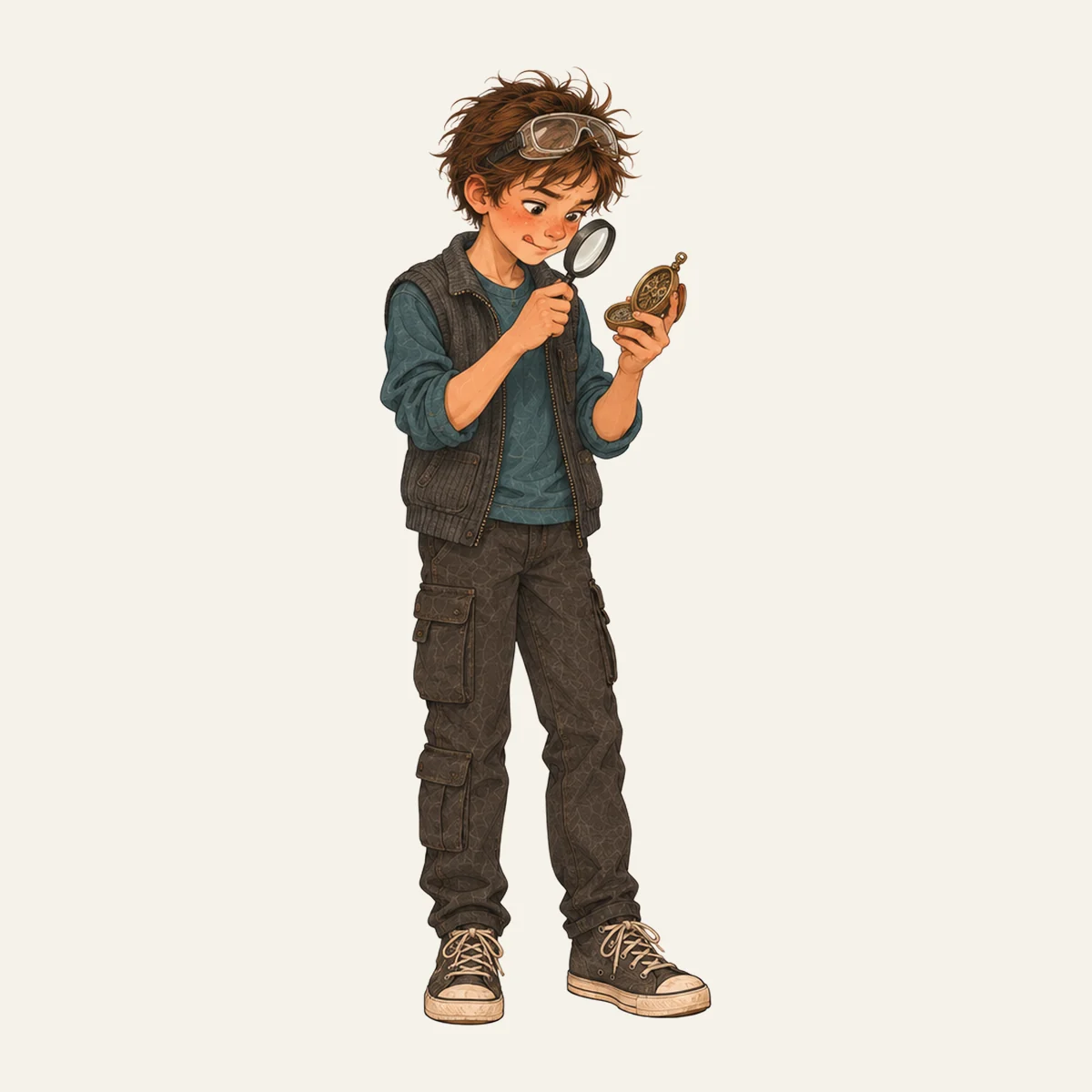
At the end of October, Daria’s yard is one giant pile of leaves. Her dad pays fifty cents per full bag, for the guinea pig fund, and Daria has calculated that with this apple tree they’re going to be rich. Christian checks her math and says, “Not rich. But enough for two bales of hay.” All the way in the back, where the old hedge is so thick you can’t see through it, Daria’s rake hits something hard. Not a rock. It sounds hollow.
Daria kneels down and pulls away ivy and dirt. A wooden box, about the size of a shoebox, dark and soft at the corners, half wrapped in a cloth that used to be oilcloth. Iron corners, a small padlock, brown with rust. Daria lifts the box and shakes it. Something clinks. “You hear that? There’s metal in there. Coins!”
Christian kneels next to her and doesn’t touch the box. He takes the magnifying glass out of his backpack and leans over the lid. Under the moss, two letters are carved, with a knife, a little crooked: “H. B.” Below them, a number, and all he can make out is a six.
“My yard, my box,” Daria says. “That hedge is older than both of us put together,” Christian says. “And the box was under the roots. Somebody put it there before the hedge got this thick.” “So it doesn’t belong to anybody anymore.” “Or it belongs to somebody who forgot about it.” Daria rattles the lock. “You’ve got your little screwdriver with you. The lock’s half broken anyway. One twist.” “I do have it,” Christian says. “That’s exactly why I want to ask first.”
“If we open it,” Daria says, “we’ll know who it belongs to. Maybe there’s a name inside.” It’s a good point, and Christian knows it. He’s quiet for a while. “And what if there’s something in there that isn’t meant for us?” “What could be in a box under a hedge that isn’t meant for us?” “No idea,” Christian says. “That’s why it’s a box with a lock.” Daria rolls her eyes. “Don’t you even want to know what’s in it?” Christian looks at her, and his face has the same impatience as hers, just quieter. “Yes. I want to know just as much as you do. I just want to know the right way.”
Then he makes a suggestion. “H. B. We ask around the street. If it isn’t anybody’s, we open it together.” “That’ll take days,” Daria says. “Not if you’re the one asking.” Daria grins, because that’s true. She can ring any doorbell and explain everything in three sentences. She runs through the names on the mailboxes in her head: “H. B.... Not Mrs. Müller. Not Filip. Not us.” Christian doesn’t say anything. He’s looking over the fence to the other side of the street, where Mr. Berger is sitting on his low stone wall, the newspaper on his knees. Daria follows his gaze. “Mr. Berger’s first name is Heinrich,” she says slowly. She knows because she once secretly wrote him a bill that she never gave him.
They walk across, Daria in front, Christian carrying the box in both hands. “Excuse me, Mr. Berger, can I ask you something?” Daria doesn’t wait for an answer. “Does a box happen to belong to you?” Christian sets it on the wall. Mr. Berger folds up his newspaper and looks at the box for a long time. He takes off his glasses and puts them back on. Then he runs his thumb over the H. “I haven’t seen that in sixty-two years,” he says. Christian does the math and looks at Daria. Mr. Berger was ten. Same as them.
“When I was your age,” Mr. Berger says, “there wasn’t a house on your lot yet. Just a field with this hedge, and we used to play soccer there.” He buried the box, he tells them, on his tenth birthday, and threw the key in the creek so he couldn’t cheat. “I was going to open it when I grew up. Then I forgot that I grew up.” Daria laughs and stops right away, because Mr. Berger isn’t laughing. “What’s in it?” she asks. “I don’t really remember. Want to find out?”
Daria looks at Christian. “Now you can.” Christian takes the little screwdriver out of his backpack. It takes four minutes, Mr. Berger holds the box steady, and then the shackle gives. There are no coins inside. Five glass marbles, that’s what clinked. A pocketknife with a wooden handle. An old coin with a hole in the middle, the kind nobody uses anymore. A black-and-white photo of a boys’ team with a soccer ball. And a tightly folded note that says on the outside: “To Heinrich, when he’s grown up.”
Mr. Berger takes the note, looks at it, and tucks it into his shirt pocket without opening it. For the rest of the afternoon the three of them sit on the wall and sort everything out. Christian lays it all out in a row, Daria asks a question about every single thing, and Mr. Berger tells stories. The coin was the first money he ever earned, from delivering newspapers. In the photo he points to a boy with ears that stick out, front row. “That’s me.” Daria asks whether he would have been mad if they had just opened the box. Mr. Berger thinks about it. “Not mad. But then you’d have had five marbles and no story.”
When the streetlight comes on, they walk back across the street. “What do you think the note says?” Daria asks. “No idea,” Christian says. “Don’t you want to know?” “Yeah. A lot.” They both turn around. Mr. Berger is still sitting on the wall, his glasses pushed up on his forehead, reading something small and white. Daria’s fingers itch, she wants to know what it says so badly. She stays on her side of the street anyway.
Are you allowed to find out everything just because you’re curious? And where does something start belonging to someone else, even if it’s lying in your own yard?
Two points of view
The box was in her yard, and she was sure opening it was the fastest way to an answer. It surprised her that asking could be faster.
He was just as curious as Daria. He just didn’t want to know something nobody had chosen to tell him.
The story does not end here.
You might have seen it differently. That is part of the point.